Last Epoch’s next season introduces a new Omen-driven combat loop across the Campaign and Monolith of Fate, while also expanding endgame routing, adding high-risk item Corruption, and reworking the Idol system with new Altars and Omen Idols.
Shattered Omens at a Glance
- Omen Windows are new two-phase encounters in the Campaign and Monolith of Fate.
- Greater Omen Windows are tougher versions that pit players against two Omens at once.
- Echo Chains add new themed routes through the Monolith.
- Timeglass Fragments are a new currency earned from defeating Omens.
- Omen’s Veil leads into Fractured Prison, which unlocks the Vision of the Observer boss fight.
- Corruption adds a high-risk crafting layer through the new Rune of Corruption.
- Corrupted amulets can convert attributes into new stat types with major upsides and drawbacks.
- Idol Altars reshape the Idol grid and introduce Refracted Slots.
- Omen Idols are a stronger new Idol type with equip limits.
- Loot filters now support up to 200 rules and gain several new customization options.
Last Epoch Season 4, Shattered Omens, looks less like a small seasonal refresh and more like a systems-heavy update built around one central idea: fight Omens, earn new rewards, and use those rewards to push into harder content and riskier item upgrades.
That makes Omen Windows the clear centerpiece of the season, but the bigger story is how much of the game they touch. Their rewards feed into Monolith routing, Woven Echoes, a new pinnacle encounter, and one of the riskiest crafting systems Last Epoch has added so far.
Omen Windows Are the Core of Season 4
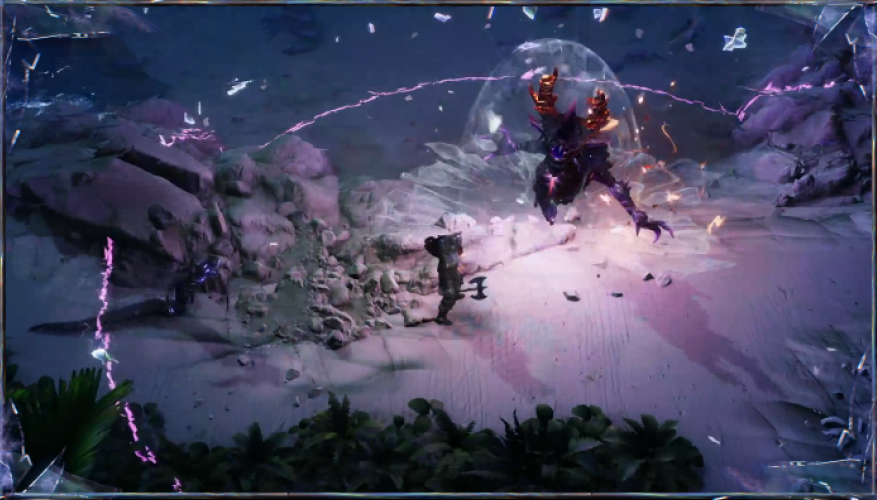
The season’s headline feature is the Omen Window, a new combat encounter that can appear throughout both the Campaign and the Monolith of Fate.
Each Omen Window plays out in two phases. In the first, players fight inside a circular area while an Omen empowers nearby enemies and summons additional threats. Killing enemies fills a progress bar, and once that bar is full, the encounter shifts immediately into phase two. This may sound familiar to some Path of Exile players.
That second phase is where the Omen itself becomes vulnerable. Defeat it, and players earn the rewards that power the rest of the season, most notably Runes of Corruption and Timeglass Fragments.
Standard Omen Windows also have a clear fail condition. If all players leave the ring for more than 10 seconds, the encounter ends. In co-op, at least one player has to remain inside to keep it active.
Greater Omen Windows Push the Seasonal Loop Further
Season 4 also introduces Greater Omen Windows, which are tougher, more rewarding versions of the base encounter.
These differ in a few major ways. Players are no longer confined to the original ring and can instead use the full Echo as the battlefield. More importantly, two Omens appear at once, raising both the pressure and the reward potential.
Clearing a Greater Omen Window grants access to a Timeglass Core, which can either award additional Timeglass Fragments or be used to spawn new Echo Chains. Greater Omen Windows aren’t just harder fights; they also help drive seasonal progression through Timeglass Cores and Echo Chains.
Echo Chains Add More Directed Monolith Routes
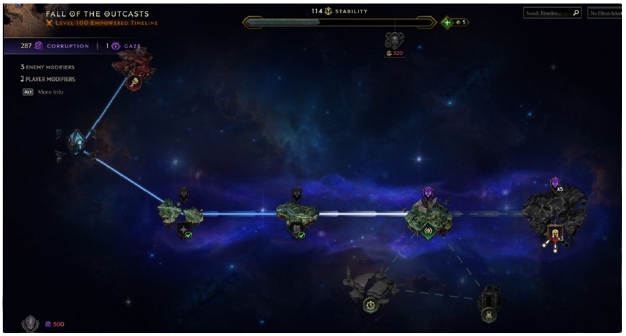
One of the more important supporting systems in Shattered Omens is Echo Chains, a new way to navigate Monolith content.
These chains can appear randomly, but players can also create certain types of them through the Timeglass Core after clearing a Greater Omen Window. Echo Chains give Monolith players more control over both routing and rewards.
Season 4 adds five Echo Chain types:
- Omen Echo Chain:
Guarantees Omen Windows in each Echo and ends with a Greater Omen Window. - Nemesis Echo Chain:
Guarantees a Nemesis in each Echo and ends with a Conquered Tower. - High Stability Echo Chain:
Awards much more timeline stability than standard Echoes. - Primal Hunt Echo Chain:
Guarantees a Rift Beast in each Echo. - Omen Window Champions Echo Chain:
Ends with a special Woven Echo featuring an Omen Window where only Champions spawn alongside multiple Omens.
For players who spend most of their time in the Monolith, Echo Chains may end up being one of the season’s most practical additions, since they make endgame routing feel more targeted instead of purely reactive.
Timeglass Fragments Power the New Reward Economy
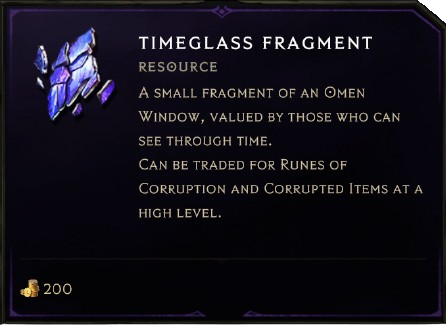
Defeating Omens awards Timeglass Fragments, a new currency that sits near the center of the entire season.
Fragments can be exchanged with Apophis in the End of Time for a range of rewards, including:
- Runes of Corruption
- Crates of Corrupted Items
- Bags of Temporal Keystones
- Bags of Ancient Bones
- and other season-related rewards
Omen Windows now sit at the center of both progression and crafting rewards. They’re the fuel source for both the new crafting layer and part of the season’s endgame unlock path.
Omen’s Veil and Fractured Prison Lead to the New Pinnacle Fight
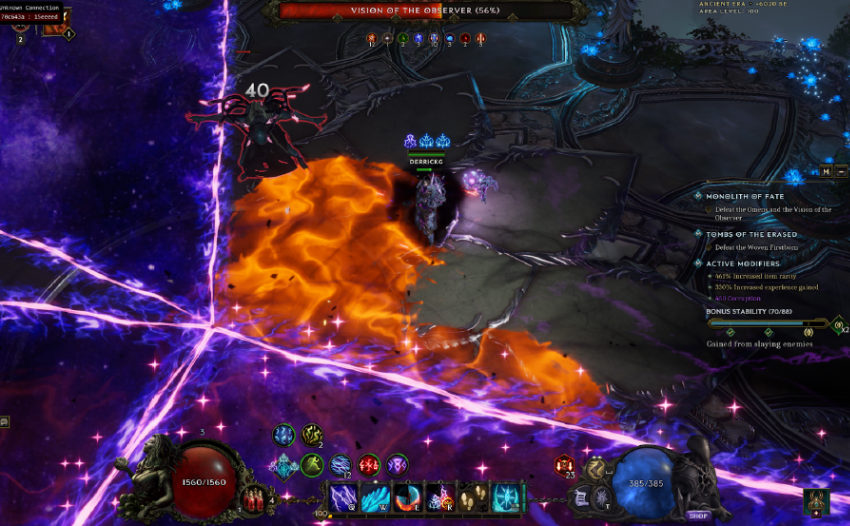
The seasonal progression path eventually pushes into Omen’s Veil, a Woven Echo that can be purchased from Apophis with Timeglass Fragments.
Once placed, Omen’s Veil creates a challenge where players encounter three Omen Windows in close proximity. Activate all three at once and clear them successfully, and the reward is a Fractured Prison Woven Echo.
Fractured Prisons are the key to the season’s new pinnacle encounter. Placing it unlocks access to Vision of the Observer, a multi-phase boss fight with exclusive drops positioned at the top of the Omen progression ladder.
The seasonal path looks like this:
Omen Windows → Timeglass Fragments → Omen’s Veil → Fractured Prison → Vision of the Observer
Corruption Adds a New High-Risk Crafting Layer
Omen Windows are the combat hook. Corruption is the season’s biggest itemization gamble.
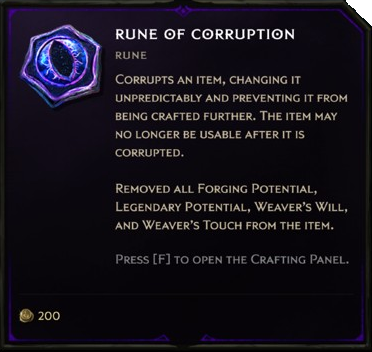
Season 4 introduces the Rune of Corruption, a new crafting rune that can be used to Corrupt an item. The upside is obvious: a corrupted item can come out much stronger than before. The downside is equally clear: corruption can damage, downgrade, or outright ruin an item.
Possible positive outcomes include:
- Adding a Corrupted affix
- Adding a normal, Champion, or experimental affix
- Maximizing item rolls
Possible negative outcomes include:
- Making the item unusable
- Lowering its rarity
- Removing affixes (oof)
- Reducing affix tiers
- Minimizing rolls
- Changing the item subtype
There’s also a major restriction attached to the system. Once an item is corrupted, it loses all remaining Forging Potential and Legendary Potential, which means it can’t be modified (or fixed) any further.
For ARPG players coming from Path of Exile, this is the closest place where a comparison actually makes sense: the broad feel of Corruption has that same high-risk, irreversible gamble energy. But Last Epoch’s take appears more elaborate in practice, especially because it introduces its own unique pool of corrupted affixes and stat conversions.
Corrupted Amulets Can Change How a Build Plays
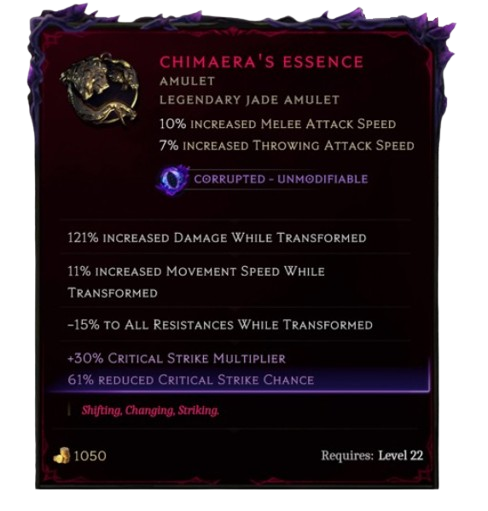
Corrupted amulets are where the system gets more build-defining. They can convert core attributes into entirely new stat types, each with a built-in upside and downside.
Corruption isn’t just a gear gamble; in some cases, it can push a build in a different direction.
There’s also an important note on rules here: these converted stats still count 1:1 toward existing attribute-based scaling. So if an effect would normally scale from Strength, its corrupted equivalent (i.e., Brutality) still counts for that purpose. So you won’t completely brick your strength stacker by rolling brutality.
Corrupted Amulet Stats at a Glance
Rampancy (from Vitality)
- 3% increased effectiveness of Frenzy per point
- 0.1% more damage taken while you don’t have Frenzy per point
This is the easiest one to explain in any ARPG shorthand. It rewards builds that can keep Frenzy up consistently and punishes builds that let it fall off.
Brutality (from Strength)
- 0.05% more damage for melee attacks per 1 mana cost, up to 20%, per point
- 0.5% reduced Health Leech per point
Brutality looks aimed at heavier melee spender builds. The upside rewards more expensive attacks, while the downside cuts into your sustain. It favors characters leaning into bigger, costlier melee hits rather than cheap spam.
Guile (from Dexterity)
- 0.3% cooldown recovery speed for movement skills per point
- 1% reduced armor per point
Guile supports a mobility-first approach. It encourages faster repositioning and more frequent use of movement skills, but trades away some defensive baseline in the process. Just don’t get hit, ez.
Madness (from Intelligence)
- 1% Spell Critical Multiplier per point
- 1% increased bonus damage taken from critical strikes per point
Madness is essentially a glass-cannon caster stat: it raises your offensive ceiling, but makes enemy critical hits more punishing. Side note: This could be OP, considering Crit avoidance is usually a standard stat casters pick up.
Apathy (from Attunement)
- 2% increased Mana Regeneration per point
- 0.2% of Current Health is lost when you directly use a skill per point
Apathy improves your mana engine, but makes active skill use chip away at your health. That creates an obvious tension between stronger resource sustainability and higher self-inflicted fragility. This could be interesting to see how ward-generating players work into this.
These aren’t just stat alterations; they’re build-identity modifiers.
Idol Altars Reshape the Idol Grid
Tired of the same old idol setup? Great news, season 4 is also altering the Idol system through Idol Altars, which may end up being one of the patch’s biggest theory-crafting features.
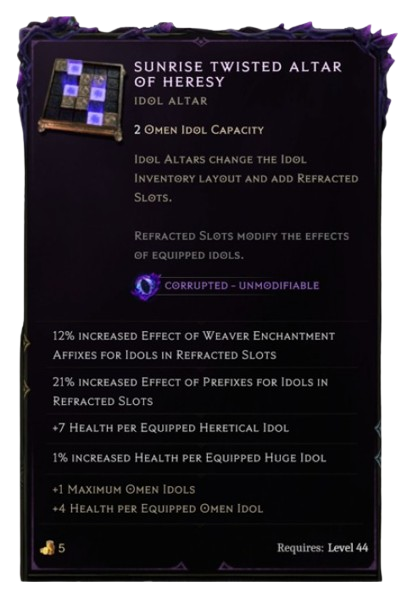
Idol Altars are equipped in a new dedicated slot above the Idol interface. Once equipped, they immediately change the layout of the Idol grid inside its fixed 5×5 space. There are 13 altar subtypes, each with its own arrangement of blocked, open, and special slots.
Some Altars can also create Refracted Slots, which appear as glowing purple squares on the grid. Idols that cross those slots gain extra benefits from the equipped Altar, assuming the Altar has modifiers tied to refracted placement.
That makes Idol Altars more than just another resistance or stat-stick item. They directly alter how players plan their Idol layout.
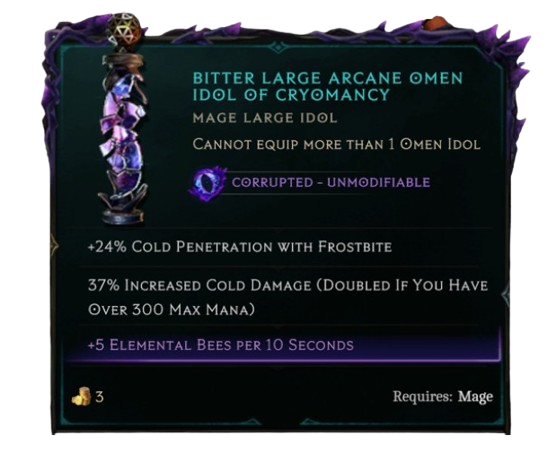
Omen Idols Add Another New Build Layer
Alongside Idol Altars, Season 4 adds Omen Idols, a stronger new Idol type that comes in 1×3 and 3×1 shapes.
These can roll modifiers normally associated with larger 1×4 and 4×1 Idols, giving them a more powerful profile than standard options. The tradeoff is that players can only equip one Omen Idol by default, though some Idol Altars can raise that limit.
Omen Idols can be earned by defeating Omens and through the Vision of the Observer boss encounter.
Loot Filters Get a Major Quality-of-Life Upgrade
Not every Season 4 addition is about bossing or item gambling. Shattered Omens is also delivering a substantial update to one of Last Epoch’s most important, arguably one of its best, long-term systems: loot filters.
The biggest headline is the cap increase on the number of rules. Loot filters can now support 200 rules, up from 75.
The system is also gaining new condition types, including:
- Potential (details below)
- Rune
- Glyph
- Shard
The new Potential condition supports filtering around:
- Forging Potential
- Legendary Potential
- Weaver’s Will
- Weaver’s Touch
Meanwhile, the old Crafting Materials condition has been split into more specific categories for shards, runes, and glyphs, giving players much tighter control over what they want to see.
Other improvements include:
- new resource entries in the Key condition
- better label recoloring options, including white labels
- customizable loot beams
- separate beam and map icon settings
- new audio cues for rarer drops
- taller beams for more valuable items
In a loot-heavy ARPG, this is a godsend QOL. Granted, this means you’ll spend some time customizing your filter, but it should be a one-and-done and will pay dividends later.
Why Shattered Omens Looks Important
Shattered Omens doesn’t add just one seasonal mechanic. It links combat, Monolith routing, crafting, and build planning into a single progression loop. Omen Windows feed Timeglass Fragments and Runes of Corruption, which then open Echo Chains, Omen’s Veil, and Fractured Prison. At the same time, the update adds new build decisions through Corruption, Idol Altars, and Omen Idols, and supports them all with a more flexible loot filter system.
That gives Season 4 a broader footprint than most seasonal updates since 1.0. It touches nearly every part of the endgame loop: combat pacing, Monolith routing, gear craft risks, idol planning, and loot management.
Fast Reference: What Season 4 Actually Changes
Combat and Progression
- Omen Windows adds new two-phase encounters
- Greater Omen Windows add tougher versions with two Omens
- Timeglass Fragments become a new currency
- Echo Chains add more directed Monolith paths
- Omen’s Veil and Fractured Prison lead to Vision of the Observer
Itemization
- Rune of Corruption adds high-risk item crafting
- Corrupted items lose remaining Forging Potential and Legendary Potential
- New Corrupted affixes can appear on corrupted gear
- Amulets can convert attributes into new stat types
Build Planning
- Idol Altars reshape the Idol grid
- Refracted Slots can enhance Idol placement
- Omen Idols add stronger but limited new Idol options
Quality of Life
- Loot filters now support 200 rules
- New filter conditions for Potential, Runes, Glyphs, and Shards
- Better loot beam visuals, audio, and customization